Residents and robots aim to restore Chesapeake oysters after 99% collapse
A Kent Island photographer and a UMD engineering team are using sonar and AI to guide new oyster plantings in the bay.
By Camila Wisniewski ·
Oyster populations in the Chesapeake Bay have plummeted, but a new coalition of engineers and local residents is working to reverse the decline using underwater robotics and community planting. The effort addresses a species that once formed vast reefs but now exists in far smaller numbers due to decades of overharvesting and environmental stress.
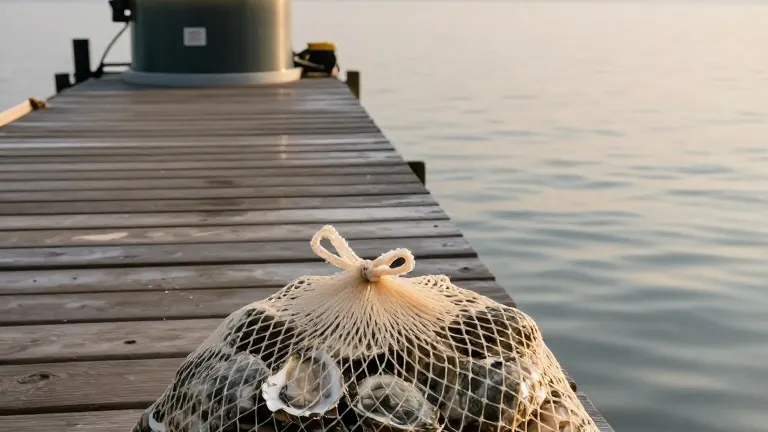
John Consoli, a professional photographer at the University of Maryland, stands on a pier at the southern tip of Kent Island, Maryland. He pulls a mesh bag filled with oysters from the water. The mollusks are three months old. Consoli notes that they weighed almost nothing when he acquired them but now fill the net so heavily that it is difficult to lift. He states that each adult oyster filters up to 50 gallons of water per day, which improves water clarity and supports sea grass growth.
The ecological value of oysters extends beyond filtration. Their shells create complex habitats for small fish, crabs, and other marine life. Consoli recently discovered a seahorse living among his oysters. According to one estimate, oyster stocks in the bay dropped by more than 99% by 2011. Ryan Carnegie, a biologist at the Virginia Institute of Marine Science, says that while farming has expanded and wild populations have seen a partial recovery, Elizabeth North, a fisheries oceanographer at the University of Maryland Center for Environmental Science, cautions that current numbers remain a fraction of historic levels.
Consoli became involved in conservation after photographing oyster research on campus. He was inspired by Miao Yu, a mechanical engineer at the university. Yu’s team faces two main challenges: locating hard surfaces for young oysters to settle and determining when adult oysters are ready for harvest. The bay’s murky water makes both tasks difficult. Yu explains that young oysters dropped into mud often die, and harvesting is inefficient because dredging can damage the seabed or pull up immature shells.
To solve these problems, Yu’s team uses robots to scan the seabed. At the Neutral Buoyancy Research Facility, a PhD student named Michael Xu steers a custom-built robot called Oysterbot. The device uses sonar to create a general view of the underwater terrain. The team also deploys a smaller BlueROV robot to capture close-up video feeds. AI software then stitches these visuals together to map oyster presence, count live and dead shells, and measure their size. Yu aims to transform these sonar images into actionable maps for oyster farmers.
Consoli has applied this technology alongside a growing network of neighbors. He calls this group the Peer to Pier Network. He estimates that roughly 80 people are now involved in growing oysters around the bay. Consoli asks new acquaintances if they know anyone who likes oysters, then encourages them to try growing their own. His wife Kathy, who calls him the Pied Piper of oysters, notes that this is the most labor-intensive hobby he has ever pursued.
Local residents report positive changes. Earl Collins, an octogenarian neighbor, says he is impressed by how the oysters clean the bay. Ann Ziegler, who lives nearby, harvested oysters with her family and ate them raw. John Patrick, another neighbor, says he has seen more croaker, crabs, and eels around his pier since installing oysters.
The project also includes larger-scale installations. Consoli worked with Libbey’s Coastal Kitchen restaurant to place one million baby oysters around their dock pilings a couple of months ago. Eight people in wetsuits and life jackets performed the installation in waters filled with jellyfish. Restaurant owner Andrew Westlin describes the project as a no-brainer and a way for the business to give back to the community. A sign explaining the project will soon be placed near the pier.
Yu’s team has conducted similar fieldwork in Washington state and along the Gulf coast. She hopes the technology can be scaled nationwide within a decade. For now, the focus remains on the Chesapeake. Consoli and his network continue to stock the bay with oysters, aiming to restore as much of the ecosystem as possible through both robotic precision and community effort.
Source: NPR