Tesla Narrows FSD Promise to Q2 2027
Tesla plans to let owners add their cars to its Robotaxi fleet in limited zones next year, rather than enabling full autonomous driving.
By Rebecca Caldwell ·
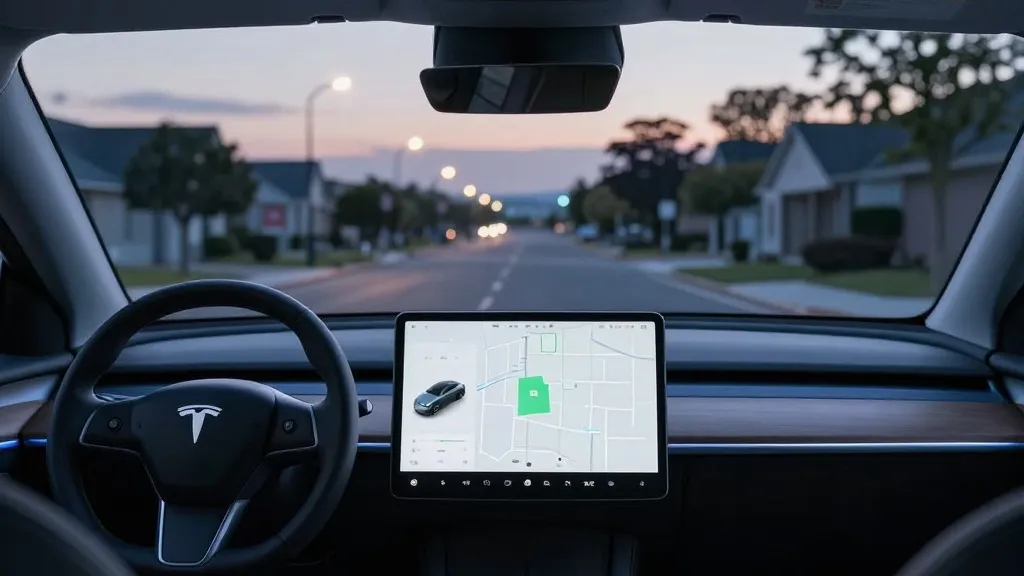
Tesla has officially set a target for the second quarter of 2027 for unsupervised Full Self-Driving in customer-owned vehicles. This announcement came during the company's third-quarter earnings call, where AI chief Ashok Elluswamy clarified the scope of the rollout. The date represents the latest iteration of a promise Elon Musk has made to buyers for nearly a decade. However, the definition of the feature has shifted significantly from the original marketing materials.
The primary distinction lies in how the technology will be deployed. Elluswamy explained that owners will not simply receive a software update that allows their cars to drive them anywhere. Instead, the system will function by adding private vehicles to Tesla's managed Robotaxi fleet. This means the car will only drive itself unsupervised within specific areas where Tesla's Robotaxi service is already active. The operation remains under Tesla's management rather than the individual owner's control.
This approach responds directly to concerns raised by retail shareholders. One of the most common questions submitted for the call, supported by approximately 1.1 million shares, asked when customers could expect unsupervised FSD in their own cars. By linking the feature to the existing Robotaxi infrastructure, Tesla is tying the availability of personal autonomous driving to the geographic limits of its commercial service. If a car is outside a designated Robotaxi zone, it will not operate unsupervised under this new plan.
The current geographic reach of these zones remains limited. Tesla's Robotaxi service operates in six U.S. metropolitan areas, but the service areas often cover only small slices of those cities. For example, the Miami zone focuses on West Miami and a strip toward Doral and Sweetwater. Similar small geofences were launched in Orlando and Tampa in July. Within these boundaries, the vehicles generally stick to low-speed routes and avoid highways. In the Bay Area, the service is not yet fully unsupervised because California rules require a safety driver in every car.
The scale of the current fleet also highlights the gap between the promise and the product. Tesla reported that Robotaxi reached nearly 2 million cumulative unsupervised miles by the end of the third quarter. This milestone came one month after the Cybercab joined the Austin fleet. Third-party tracking from this spring indicated that the number of fully driverless Teslas on the road is in the dozens. This is far fewer than the hundreds of thousands Musk previously discussed. Meanwhile, competitor Waymo already operates in Orlando and Tampa and has surpassed 3 million miles.
This new target diverges from the pitch given to FSD buyers for years. The original promise was a car that would eventually drive itself anywhere through a simple software update. In July 2025, Musk told investors that unsupervised FSD would be available for personal use by the end of that year in certain geographies. A year prior, he expressed surprise if the technology was not ready the following year. Additionally, owners with hardware version 3 have been informed that their computers cannot run unsupervised FSD, with no clear upgrade path provided.
The shift narrows the product definition considerably. The goal is no longer a car that drives you home from the airport or takes you on highway road trips. Instead, the car joins Tesla's fleet within specific, controlled zones. This moves the goalpost from universal personal autonomy to a limited, geofenced service. For many owners, this means unsupervised commuting is only possible if they happen to live and work within one of the designated Robotaxi areas.
Elluswamy noted that safety remains the primary bottleneck for expanding the system. Tesla limits itself to low-speed roads and avoids complex environments to manage risk. He suggested that these safety issues could be resolved by next year, though he acknowledged the uncertainty. This cautious approach reflects the company's strategy to prove reliability in controlled settings before expanding to broader personal use. The Q2 2027 date should be viewed as an estimate rather than a guarantee, given the history of shifting timelines.
For consumers in the Southeast and beyond, the outlook suggests a phased introduction. Buyers should expect the unsupervised feature to be tied to specific local services rather than a global capability. The focus on small geofences and low-speed routes indicates that Tesla is prioritizing operational safety over geographic speed. As the company continues to refine its Robotaxi network, the integration of customer vehicles will likely follow the same pattern of gradual expansion from limited zones to wider areas.
Source: Electrek · original report published