Sudanese children earn pennies on the streets as schools close
Eight million school-age children are out of classes in Sudan, with some working for under a dollar a day to support their families.
By Camila Wisniewski ·
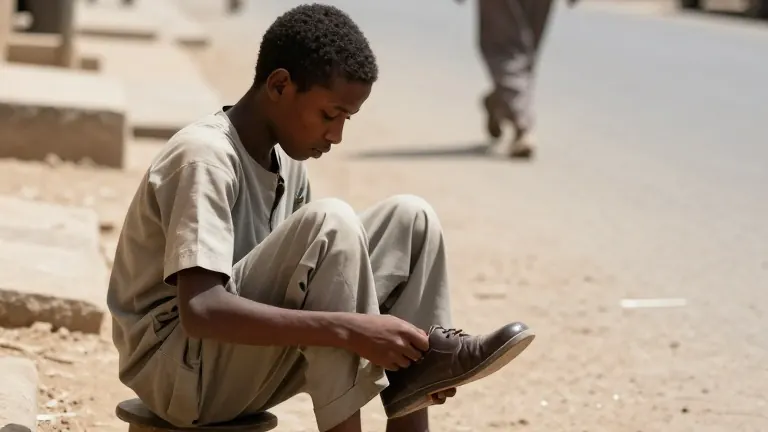
In Port Sudan, a nine-year-old boy named Abkar Mohammed cleans and polishes shoes on the city streets. He earns approximately 10,000 Sudanese pounds, or $1.08, for a full day of work. He hands the cash to his mother to buy food and cover daily costs for his family. The family lives in a rented home in al-Kasara, a low-income neighborhood. Abkar does not attend a formal school. He studies the Quran at a traditional khalwa during the day. He travels by public transport to work in busy areas. He returns home before sunset.
Abkar is part of a larger group of displaced children. UNICEF reports that 8 million of Sudan's 17 million school-age children are currently out of school. The country has been at war since April 15, 2023. The conflict between the Sudanese Armed Forces and the Rapid Support Forces has disrupted education nationwide. In Darfur, about 80 percent of schools remain closed. Seventy percent of children in that region do not attend classes.
Save the Children estimates that children have missed an average of 484 days of classroom learning since the war began. School buildings are often damaged or destroyed. UNICEF says nearly half of all school buildings in the country no longer function as classrooms. In September 2026, a drone attack on warehouses in North Kordofan destroyed more than 330,000 school textbooks and other learning materials.
The economic pressure on families drives children into the workforce. Saliha Omer, who sells tea in Port Sudan, could not enroll her 11-year-old son in school due to financial constraints. He now works at a grocery shop. She plans to return to Khartoum in the coming days so he can attend classes. Another child, Mahmoud al-Ghali, has not been to school since he was 13. He sells sweets and crisps on the streets of Port Sudan. He makes a daily profit of about 20,000 Sudanese pounds, which is less than $3.
Mahmoud has been displaced several times. He moved to Port Sudan in July 2025 to earn more money for his family. He says he has little hope of returning to school himself. He hopes to save enough money to expand his trading business. His two younger brothers have returned to classes in Gaziera State after the Sudanese Armed Forces regained control of the area.
Sulaima Ishag, head of the Government Advisory Council for Women and Children, notes that children in conflict zones are at greatest risk of permanently losing access to education. She points to increased cases of child marriage and sexual violence among girls. Eva Hinds, UNICEF's head of advocacy in Sudan, warns that repeated displacement disrupts learning. It separates children from teachers and classmates. Hanaa Mohamed, a psychologist, says prolonged displacement has caused sleep disturbances and behavioral changes in children.
Sudan's economy has been set back 30 years by the war. Sixty percent of Sudanese people now live in poverty. Few jobs are available for adults. This forces parents to rely on their children for income. The loss of school as a safe space exposes children to child labor and recruitment by armed groups. The financial strain continues to limit educational opportunities for displaced families.
Source: Al Jazeera
More Business · Rip-Off Report · Report a business · Got a Story?